Sunday, 6 January 2013


Review of William Boyds
Any Human Heart

 Never say you know the last word about any human heart”
                                                                          
- Henry James

First published in 2001, Any Human Heart by William Boyd is the intimate journal of fictitious character Logan Gonzago Mountstuart, the son of a corned-beef manufacturer from the midlands. Boyd employs Mountstuart’s romantic readiness, lapsed genius and artistic endeavour to make sense of the major events of the twentieth-century, he is the beating heart that is placed into a dead age and who not only brings it to life but lends to it a wonderful sense of human significance. Boyd, through Mountstuart’s journals matches a degree of feeling to historical fact and makes a century that is so dominated by wars, institutions and dates in time to something tangible, enjoyable, laughable and yet also tragic.

Logan Mountstuart is portrayed as a furious writer whose journals begin at school and finish in his senility in France, they account the stratospheric highs and dog-food-for-dinner lows of a man who has experienced both success and failure as an Oxford graduate, as a novelist, a journalist, naval officer, art-dealer and as a father and husband. The reader is invited to accompany him on a journey through a life dominated by two dis-proportionate measures of good and bad luck that seem to fluctuate throughout the narrative and dictate the protagonist’s life. The implication that neither man nor deity has control over life is an interesting and thoroughly pragmatic sentiment that resonates throughout, after all Logan says it’s really all just luck in the end.

Mountstuart’s life is not only characterised by luck but by a series personal encounters with figures both real and fictitious. Often these encounters render the narrative a little unbelievable, especially in a work of realism and certainly there are elements to the narrative plot that are alarmingly un-authentic.

Take for instance the protagonists knack for befriending iconic people, finding himself ingratiated with the Modernist literati in Paris as a young man; mixing with Hemingway, Stein and Woolf. We are led to believe that he has in someway managed to penetrate the academic elite without any effort at all, drinking and frolicking with literary idols to such an extent that one might be forgiven for thinking that the events had been plucked straight from the wet-dreams of the author, William Boyd.

Indeed the realism is placed into jeopardy on other occasions too; Mountstuart works with Ian Fleming, plays golf with King Edward VIII, is called Judas by Wallis Simpson and later on in life stumbles into a KGB bomb plot. Whilst all of these peculiar coincidences are explained reasonably well in the journals there seems to be something of a sycophantic hand behind it all, as though Boyd feels that Mountstuart’s journals would be uneventful without him bumping into somebody the reader might recognise from the history books.

Rather that all seems to me a bit pointless and kitsch. I am far more interested in Mountstuart’s character, his peculiarities, stubbornness, his ailing marriage and romances are more personally significant than the murder of Sir Harry Oakes or Mountstuart's lack of appreciation for Jackson Pollock. Whilst the inclusion of real-life characters does give the novel some identity and some place in real time it detracts from the narrative and distracts attention away from the one human heart that we are reading the novel for. One gains the impression that, for Boyd it is important to establish Mountstuart’s character by defining those who are around him but to me it feels so plain and unashamed in its sycophancy that it is jarring and difficult to comprehend.

Despite the fabricated authenticity of the journals and the often-unnecessary inclusion of historical figures, Any Human Heart redeems itself through its pseudo-philosophical vehicle that Logan Mountstuart embodies. When faced with religion the protagonist resolutely tells it to ‘fuck off’, this along with his devout belief that a man’s life is defined by luck says something more about the age than his involvement with famous figures.

Boyd, through Logan’s cynicism, suggests that the twentieth-century was an age of pessimism and non-belief, of atheism and thought. This idea is captured perfectly when Logan returns to his home in Battersea to learn his wife and child have been killed in a V2 bomb attack. Who could believe in any conscious Christian deity that would let something of that destructive nature happen? And who would ever respect the sacrament of marriage during the sexual revolution of the sixties?

Undeniably it is the documentation of Mountstuart’s everyday life that defines the time more so than simple world events; his alcoholism, debts and promiscuity, his failure to commit to a novel and his failure to raise his son whilst in conjunction with wider events is where the human heart is found and where the novel is at its best. That is where realism is achieved and no questions are asked about authenticity.

Indeed the novel is not a work of genius, it doesn’t leave one with the feeling that his life has been changed by reading it, but often we do not read things for our lives to be changed by them. We read because for perspective, for thought and for a fresh take on the things we thought we already knew; certainly if you are in this vein of thinking then you should read Any Human Heart.

 
It will have you hankering after every word Mountstuart says, will have you relating to his struggles as a young writer and father and most importantly will make you think about the futility of life - no matter where it was you started, you could be ending your days at any point and that if you do make it to the ripe old age of eighty-five with a bottle of chilled wine by your side and the collected plays of Chekov open on your chest then perhaps life could not have been all that bad.

Richard Cunningham

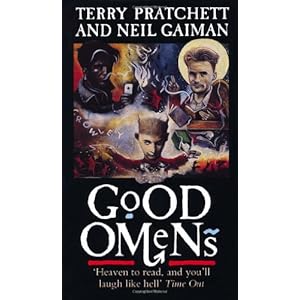
Good Omens

by Neil Gaiman and Terry Pratchett


With the Mayans prediction of apocalypse on December 21st falling through, what is a more fitting book to read than ‘Good Omens’?

This fantasy comedy is written by two acclaimed and award winning writers of sci-fi and fantasy fiction: Neil Gaiman (author of ‘American Gods’ and ‘The Sandman’ graphic novel series), and Terry Prachett (author of ‘The Discworld series’ and ‘Dodger’).

‘Good Omens’ involves the birth of the antichrist, with an angel called Aziraphale and a demon named Crowley’s efforts to avert the impending apocalypse, because despite its faults this planet isn’t half bad. These two giants of fantasy fiction have not only created a tale that turns figures from Christian mythology on its head, but paints a picture of a very english armageddon. This quirky and entertaining narrative features an end of the world where demons drive Bentleys, are responsible for the M25, have lunch with angels at The Ritz, where angels own bookshops in Soho, the four horsemen are bikers and where the antichrist lives in Tadfield. 

The list of absurd characters and irreverent satires goes on and on but occasionally the plots are as easy to mix up as the antichrist at a Satanist hospital. With many interweaving characters and subplots that veer to and fro, it takes you on a journey that leaves you laughing, crying and thirsty to read more. The characters created by the dual authors are well formed, fascinating and funny - who could not help but love a literary double act such as the demon Crowley, “the Angel who did not so much fall as saunter vaguely downwards” and his unlikely friend, the angel Aziraphale - part time dealer of books and lover of tartan. The unlikely friendship between the two beings is one of the key narratives of the books, and contributes heavily to the books hilarious lighter moments.

You can really see the individual authors input throughout the book, whether it is Prachett’s tendency to ramble on in a controlled manner, manufacturing the books best pieces of comedic wit, or Gaiman’s pennant to re-imagine supernatural characters in modern settings, and write deep and multi-faceted plot lines.
Because the book is written in a fantastical style and light mannered tone throughout, it can sometimes be too light. Isn’t it the moments off darkness sandwiched between periods of light in life what makes the good times seem much brighter and the jokes much more funnier? Darkness in a novel gives the reader a chance to feel more for the characters, and allows us to enjoy the book more since we have a sense of the heightened feeling that comes from following the peaks and troughs of the books emotional roller coaster. To surmise the book seems to be missing the gravitas that would transform some parts of good omens into great omens.
Similarly, as exciting as all the merriment and hilarity seems to be at times, it can seem a bit too convoluted and it leave you a bit behind if you are not used to the fantasy genre or numerous back and forth narratives which is generally used to great effect in the authors other works. Prachett’s rambling style especially can be tricky for the reader unused to it.
Always light hearted, sometimes ‘Good Omens’ seems to be missing a sense of seriousness that would transform some parts of good omens into a really stellar read. However despite its sins ‘Good Omens’ is an immensely enjoyable book that would lighten up anyone’s apocalypse – An “ineffably” good read.

 Reviewed by Jade Bennett.

Bel Canto- Ann Patchett


  Bel Canto is a novel that displays the best and worst of humankind. In a beginning that is fast paced and violent, the reader is introduced to a set of unsavoury characters, from the barbaric nature of the terrorists, in particular the generals, to the worshipping mannerisms of Roxane Coss. Yet, Anne Patchett beautifully dilutes this prior chaos and constructs a place of familiarity that soon becomes a home of security to all those within it.

  
  The novel forces us to subconsciously to change the way we view human nature. Anne Patchett’s intensely descriptive narrative strips down the false façade of individuals to reveal a raw portrayal of society. She is able to hold a certain ability to entrance the reader throughout, to the extent that we too become the hostages, experiencing the tale of prohibited love.
  
  Her subtle use of understated humour compliments much of her work. It is neither laboured, nor rarely used, but merely enhances the beauty within each of the characters. Although, it may not appear as stereotypically humorous, she is able to define and perfect each of the individuals’ mannerisms, to the extent that the witty narrative is not obvious, but added in within their public and private observations. The amusing narrative becomes more prominent as the tale progresses, and so too do the terrorist’s mind-sets, and attitudes, that soften towards the hostages.
  
  On the surface, it is a situation that appears so brutal, yet it is so quickly overturned into a secluded euphoria. What becomes surprising for the reader is that a certain affection is developed for the characters. With the absence of a clear protagonist, the weight of the narrative falls upon each of the individuals. Hitherto, as the novel progresses it is difficult to distinguish ones fondness between those of the hostages and the terrorists.
  
  Anne Patchett carefully addresses the matters of courtship and love. We, as the reader, are not forced to believe a set of blundering characters professing their love. But instead we are introduced to the delicate issue of clandestine love. The unlikely romance that ensues between Mr Hosokawa and Roxane Coss, is born out of their close captivity. Ann Patchett subtly plays out their elegant courtship. What causes this to differ from so many other romances is that their sentiments of love are not directed through dialog. Indeed, with the help of Mr Hosokawa’s employee; Gen the translator, they are, to a certain degree able to pass on public affections. However, what is so endearing about their love is that although everything within the house is so public; their intimate relations within Roxane Coss’ bedroom are kept private. Not only is it a secret from the household, but also from the reader, for Patchett chooses to leave their love behind closed doors. Indeed, this makes it a more beautiful and respected courtship. With the lack of dialogue between them, they become reliant upon one of our most basic forms of interaction; body language.
  
  In comparison, Patchett also presents the reader with the more thrilling and strictly prohibited love concerning Gen, the hostage, and Carmen, the terrorist. Their romance escalates from Gen teaching the young terrorist how to speak English. Patchett does not throw the reader into a sordid affair, but instead we see that it is born out a yearning of education. Carmen only learns that she desires Gen through her initial want of wisdom and knowledge.
  
  Patchett cleverly lulls, not only the hostages and terrosists, but also the reader into a false sense of security. Once past the initial rush, as the hostages are faced with a barbaric battlefield of mistreatment, the novel takes a steady pace and the individuals partake in a series of monotonous everyday activities, such as chess. However, one is completely unprepared for the explosive ending. Ann Patchett is a master of creating the conclusive unexpected. Throughout the novel, we form bonds and affections for both the hostages and terrorists. It is with this connection that makes the ending so hard to accept. It is at this point that we question ourselves, for the military break in, should, if asked at the beginning of the novel, be the correct and immediate thing to do. However, the euphoria instilled within the house becomes so hypnotising and secluded, that the destruction of it becomes as horrifying, if not more so, than the initial terrorist break in. The emotional ending sees humanity at its most stripped of false pretences. We see powerful figures, such as the Vice President (Ruben Iglesias) weeping over what he feels to be a son of his in the young terrorist; Ishmael. Ann Patchett skilfully concludes the novel as romance still ensues out of the memory of the loved ones lost.
  
  Patchett ultimately proves to be the master of novel’s destiny. She intertwines the brutal resilience and frustration of politics with the tender course of love. It is, in my eyes, a book that engages the reader entirely, and plays out what can only be described as the best and worst of humankind.

Sophie Fowler-Tutt


American Gods - Neil Gaiman


Only the Gods Are Real

It would be both incorrect and lazy of me to tell you that American Gods by Neil Gaiman is actually about American gods. For starters, the main gods are immigrants. (I would tell you exactly where they hale from but I fear that constitutes a spoiler.) So what is American Gods about? What kind of a novel is it? The short answer would be that it’s a fantasy novel about gods in America, but the longer and more accurate answer would be that it’s a road trip novel that also has elements of the best kind of fantasy novel. It’s a twisty sort of book; in some places, crime thriller, in others, a story about the old times making way for the new age.

   However, I would expect nothing less from a man as artistically ‘twisty’ as Neil Gaiman. You may know him from many places or from only one; he has written a massively successful graphic novel series, numerous children’s books, an adult fairy tale and a book about the apocalypse in collaboration with Terry Pratchett, not to mention his most recent forays into screenwriting (his second episode of Doctor Who will air sometime in the spring of 2013).

    The novel asks big questions and tackles large themes, but begins small; we meet our protagonist, Shadow, in prison. As you might gather, character names are clues for the avid reader. Shadow’s name is less a clue and more a signifier; as soon as we think we have the shape of him, he twists and bends.  Even what he looks like is vague; all hints of physical appearance are given by other characters, although a recurring statement is that Shadow’s a ‘big man’. Shadow is released early when tragedy strikes, and he might have just drifted into oblivion had he not met the mysterious Mr Wednesday, a grey giant of a man who claims to be both a two-bit con artist and a former god and seems to know everything about Shadow, including how to push his buttons. When Shadow accepts his offer of a job, the two of them set out on a road trip that comprises of the entirety of America and even ‘backstage’, a place beyond the world where gods can walk freely and time has no meaning.

   Gaiman himself stated that he wanted to write a ‘sprawling novel about America’, and the book does indeed sprawl. Here is where I would insert a word of caution; the structure is rather unconventional, and there are chapters that may seem superfluous at first, as they are completely outside of the main narrative and often feature characters that don’t reappear again. Yet there is a clear theme of ‘coming to America’, and without wanting to give too much away, each story has a very clear link to the people who appear and the action that happens in Shadow’s present. The shape of the novel is one that demands attention; this isn’t a book that can be read with one eye on something else.
   The structure is not the only thing that needs a keen eye; Gaiman is famous for his high level of intertextuality, and American Gods is no exception. There are references and cameos from Edgar Allen Poe to e.e. cummings to Lassie to Gaiman’s own work, The Sandman. It sounds much heavier than it actually is; the story is exceptionally intelligent, but it is never ostentatious or self-conscious, which it easily could have been in the hands of a lesser writer.

   The gods featured in the novel hale from all over the world, echoing the actual melting-pot population of America itself. That feature of the novel is a personal favourite, as it’s an incredibly true and clever way of showing us the history of America without ever telling us.
   Despite the clear mythological overtones, it would seem that casual readers are not the only people to have had trouble with classifying the book in terms of genre, as American Gods has won the Nebula and the Hugo under the category of science fiction, the Bram Stoker Award for horror and yet another for fantasy (the Locus Award). However, this ambiguity is no slander to Gaiman’s writing, rather a testament to how good it is. The overall story has a clear place in the fantasy canon, yet there are passages where it truly seems like a horror story, in others, like a whodunit tale. If one were to sum up Gaiman’s writing in a sentence, it would be that ‘mysteries last longer than explanations’; there are quite a few things left unsaid and questions left unanswered at the end of the novel, yet it doesn’t feel like an unsatisfying read or lazy writing, merely as if there are things that we are not privy to us as mortals. It’s a fabulous, fantastical, timeless novel that will no doubt become a fantasy classic and stay one.

   Oh, and if you do ever get round to reading American Gods, the answer to your question is yes, yes she did eat him. Like that.

Garen Abel-Unokan

Saturday, 5 January 2013

The Sense of an Ending


Does character develop over time? In novels of course it does: otherwise there wouldn’t be much of a story. [103]

When I first approached this book it was with a sense of trepidation.
With a pile of books already waiting on my bedside table, I took my Mum’s suggestion and read this post-Booker Prize novel.
There’s definitely a stigma attached to a Booker Prize book, for me at least. I entered into it expecting each word or phrase to be something intensely profound, some fantastical way of using language I’d barely even imagined.  
The Sense of an Ending did not do that.
But, I enjoyed it.
Put simply, it is a good book.  But I didn’t think it was a great one.

At first I sort of plodded my way through the pages of the book, following Anthony Webster’s life from school to retirement.  The entire first part of the novel is a 56-page retelling of Tony’s outstandingly average life.
The Sense of an Ending is in itself a great reflection of reality; every event seems natural in its structure and scope and it’s all pretty believable. Barnes is fantastic at reflecting life and all it’s little nuances.
But for me this raised a question: How realistic can you be before becoming mundane? Tony’s life seemed so unremarkable; every character seemed like someone I sort of knew or had met before and most situations were the sort we all experience.  It was all very… normal. And yes, to an extent this is brilliant. Writers often strive to make their world seem real, to simulate real life and have the reader feel they were part of it. But I was getting a bit bored of Barnes’ world. Tony sums it up rather nicely at the end of Part 1:

It’s been interesting to me, though I wouldn’t complain if other found it less so [56]

Less so indeed, Tony.
I was a bit bored. That was, until Veronica.

Veronica, Tony’s university ex is clearly the defining figure here.  She is established in the first half and she added a bit of colour then. But it’s in the second that she becomes the central mystery and interest to the novel. She was the reason I’d lean back out of the book, go ‘WHAT?’ and actually keep reading. I’m a sucker for a story with a mysterious character. I still remember reading The Great Gatsby for the first time and being pulled along by the revelations of whom the enigmatic Gatsby really was.
Now, Veronica is no Gatsby. Her backstory is a tad more grounded than his and there’s no extravagant parties or dramatic events where we meet her, only a couple of meetings in M&S and a Volkswagen Polo. But, Veronica is exactly what the book needs. She breaks the expectations of the reader, acting strangely and out of the norm. And when you learn more about her, including a great revelation at the climax of the book, you’re interested again.

Yes, aptly it is the ending that is the most dynamic and gripping part of the novel. I’ve found that at the end of a good book there’s this feeling, described by some as a ‘Book Hangover’. You feel like somehow you’ve been changed by the words you’ve read and been so wrapped up in its world that you’re not quite the same as when you started.
And though Barnes’ novel certainly wasn’t life changing for me, the end did leave me feeling satisfied. It tied up nicely and explained things for me. And it left me with a few things to think about.

There’s something to be said about capturing stream-of-consciousness and memory here too. Barnes does a good job at showing the tangents that the mind goes off into, the little ideas that pop into your head and memories that unearth themselves. I always enjoy explorations of memory and storytelling and how character is built through because it is so integral to a book. I learnt a lot about Tony in just 150 pages through clever little tidbits of information and well-placed flashbacks.
Barnes also sprinkles little mini-discussions on the idea of the novel into the book, which do elevate the novel above a simple mystery or love story. They’re a little contrived; most of them seem pretty obviously to be Barnes questioning the reader, rather than Tony speaking his mind. But, they were interesting and thought provoking, and that’s something I found myself needing from the book.

Barnes defends Tony’s blandness in these, where he reveals that although Tony once wanted to ‘live as people in novels live, and have lived’ [93] he played it safe instead and ‘would never do those things adolescence had dreamt about’.
This I do admire. That Barnes, and even Tony, recognises the plainness of most of the events of the novel. By addressing it, it’s clear that they’re meant to be a bit dull, they’re meant to be everyday because that’s what Barnes is showing.
And that’s all good. The book is a great reflection of what it feels like to look back and feel you’ve been missing out. But, and maybe it’s my own adolescence speaking, I just needed something more.

The Sense of an Ending was not perfect.  It was not an instant classic for me, and I might forget about most of it at some point. But. It was a well-observed foray into one average mans life and it was a generally witty and well-written book. And you know what? The end wasn’t half bad either.

Jack Rigby

Cannery Row


Surely one of the best ways to really get to know a country and its people is to read its literature? It was in this spirit that I turned to John Steinbeck rather than a Rough Guide to accompany me on my Californian adventure last summer. As Steinbeck and his poodle took a road trip across the United States in Travels with Charley, I hit the road to his hometown of Salinas and explored the settings of some of his greatest novels. But as he observes so astutely in that same book, “many a trip continues long after movement in time and space have ceased”. So in the bleak Scottish mid-Winter, about as far away from Steinbeck Country as I can get both geographically and spiritually, I tried to eke out my Californian summer just a bit longer. The dreamy haze of Monterey has lingered over me ever since and Cannery Row was the perfect excuse to revisit it.
            For Steinbeck, memory lane is a real street and it’s called Cannery Row. (In fact, it was called Ocean View Avenue until the city of Monterey renamed it in his honour.) The book lets us stroll down and peer into the elements of his past that reside there. All along the waterfront street you would pass huge canneries, processing the morning’s catch of Pacific sardines. At number 800 would be the Biological Laboratories owned and operated by Steinbeck’s best friend, Ed Ricketts, the man on whom the character Doc is uncannily modelled. Over on the other side would be a Chinese grocery, just as it appears in the book. And it wouldn’t be entirely surprising if any of the characters wandered out in front of you. After all, the book makes you sure that Steinbeck must have met these characters at some point, so vividly do they appear on the page.
            The novel is not one of plot – though there is a sparse one in which a few down and outs try to throw Doc a birthday party, twice, both times ending disastrously – but one that invokes an atmosphere, a time and a place. Set in the Depression era, it does more to capture the American psyche at a certain point in time than Fitzgerald and Hemingway combined, perhaps because it doesn’t try to. Aside from one lonely gopher there are no dreamers in Cannery Row – this is an America without a Dream. Instead there is a gritty realism to the characters’ approach to life, which makes the novel not dark exactly but sort of melancholy. They live on the brink of existence and one or two people even step over the edge, with suicides that haunt no more than a page or two, before life carries on as before. Henri the painter has notably spent over 10 years building a boat he will never sail because he’s afraid of the sea. Still, there are glimpses of the best of humanity and the struggle to make life better, like in Mrs Malloy who nags her husband for new curtains, even though they live inside a windowless boiler.
            From the beginning Steinbeck is quite clear that there will be no clear structure, no through line from beginning to end. Instead he tells us that it is best “to open the page and to let the stories crawl in by themselves.” Consequently the unrelated anecdotes that pepper the book are unforced and natural. These little vignettes that break up the main narrative make the lack of plot not only bearable, but quite enjoyable. They place the inhabitants of Cannery Row carefully before us, to observe and study, like specimens in one of Doc’s tide pools. In these snippets of life they tell us more about human nature than the most exquisitely detailed character could. Even the wildlife, which is described in such beautiful detail, inhabits the Row so very meaningfully – from Darling, the dog that will not be housetrained, to the gopher who, in creating his paradise, dooms himself to a life of isolation.
            Sometimes reminiscent of Joyce’s Dubliners in its painstaking portrayal of a specific place and the monotony of life there, the narrative sometimes breaks out into a moment of heightened poeticism, or terrible beauty where the metaphysical bubbles up to the surface of the naturalism. A boy confronts the Chinaman in the street, only when he looks into his eyes he sees “the desolate cold aloneness of the landscape”; Doc is attracted to something white moving in a tide pool to find that it is the corpse of a young girl, its purity and stillness magnified by the water. These images are what transform the novel from an astute and witty observation into something much more extraordinary.
            Cannery Row is more detached and nostalgic than God in the Pipes, a similar earlier project in which Steinbeck’s contempt for the middle-class of his hometown is more cutting. Perhaps his move to the East Coast and time as a war correspondent mellowed him and allowed that mist to descend over Cannery Row that makes you idealise a place you once knew. In much the same, my memories of the bright and touristy Monterey have given way to the literary, Steinbeck version of events. But perhaps more importantly, Steinbeck returned from Europe where the war had replaced his faith in the goodness of people with a cynicism that forced him to turn from the incomprehensible magnitude of the war to the personal and the detailed . He uses the minute and the intricate to try and make sense of the whole, of life, and thus Cannery Row becomes a microcosm of the human race. Again, it is like a tide pool representing the entire ocean. 

Seona McClintock

Tuesday, 1 January 2013

Is It Just Me? by Miranda Hart (final version)


Are you sitting comfortably? Do you have a couple of biscuits at hand and a mug of tea? Okay then, My Dear Reader Chum (as Miranda Hart would say), let’s talk about Is It Just Me?

In this day and age we have twenty four hour access to videos of talking dogs on the internet and comedy films and TV series available for us to watch on our smart phones/tablets/laptops on the train to work when you are supposed to be reading over that report your boss gave you last week. It can sometimes be difficult for the written word alone to make us laugh. Miranda Hart manages it effortlessly in her new book: Is It Just Me? Her autobiography is so animated that you can almost see her walking through a restaurant with toilet paper trailing from one of her shoes without the need of a TV screen. If you are a fan of her TV series then you will already know that she is a comic genius. If you are not a fan then I still urge you to read this book as her sparkling anecdotes come to life in ink form.

Don’t get me wrong, the TV character of Miranda is still present throughout. If you have watched the series then you will know that every episode includes conversations with us, her ‘chums’, and her book is no exception. It is a technique which she uses to her advantage, drawing you into her chaotic world. However the real Miranda surfaces from underneath through her honest confessions about her real life off the screen. She travels back in time to her school days, an awkward time for anyone, let alone for an ungainly teenage girl. We can start to see why Miranda’s awkwardness began. Growing up in an all-girl boarding school where it was common knowledge that you could get pregnant by sitting on a rugby ball (you can’t by the way!) it is no wonder that her life is so full of mishaps. She says herself that life has ‘a tendency to throw up difficulties’ and is it just me or is she right? Who hasn’t had an awful date or humiliated themselves at a family reunion? By writing what she likes to call her ‘Miran-ual’ Miranda tells tales of pure embarrassment that will have you in stitches, proving that no matter what situation you find yourself in you can always laugh about it later. Through the nature of her misfortunes she asks us whether it is just her in the world who manages to find herself in awkward situations at least once a day.

Some of the events that take place in the book are repeated in the TV series, yet she manages to shed new light on them. Her book becomes more about her musings on life than it is an autobiography as she explores each event and asks: why exactly is this embarrassing and why can’t life just be simpler? If you have watched the TV series you will know that she defies her mother’s snobbish behaviour and refuses to run with society’s common belief that a woman’s aim in life is to get married. These beliefs burst onto the page in the form of female empowerment. She describes the main events in her adult life through imagined conversations with her 18 year old self who had all these dreams and ambitions of getting married and having a respectable job such as a lawyer or doctor. She imagines that her younger self would call her a loser for not yet being Prime Minister but replies that she wouldn’t change a thing; that deep down she’s always wanted to be a comedienne, even if it’s not the most respected of professions, and that even now at the age of 38 she still doesn’t feel ready to settle down. She has got to the nub (great word, nub) of life: who wouldn’t want to go back in time and tell their former self that life isn’t going to be exactly what you think… In fact, it is going to be even better!

Separate to the serious elements of the book, the events are retold in a light-hearted nature and appeal to the humanness in all of us, for as the saying goes we do all make mistakes. It is a great book to have around if you have had a bad day at the office or, just an example, if you walked around for an hour today with your skirt tucked into your knickers and nobody had the common decency to tell you (certainly did not happen to me… Yes it did). Miranda highlights the fact that we can all feel alone in the ridiculous moments life throws in our way, but this embarrassment is actually what brings us closer together. We all feel it, so why do we keep running and hiding from it?

Although it’s easy to relate to her on this level, sometimes the events in Miranda’s life are so farfetched that you start to wonder whether they are true. That just made me sit back and think more about all of the strange things that have happened to me and that if I did write them down no one would ever believe me in a million years. I think we all need to be a bit more like Miranda in life. I don’t suggest we should all make a TV series or write down all of the cringe worthy experiences that we’ve had in our lives (for me that would take up more time than I actually have). Instead, when life gives us lemons we just need to sit down - making sure there is actually a chair there first - and laugh, then repeat after Miranda: ‘life, eh?’
I suggest you gallop off to your nearest bookstore right now and buy a copy of Miranda Hart’s Is It Just Me? as you are guaranteed plenty of laughs. A great gift this Christmas!

Georgia Fish